Bisbee, Arizona
What is the Bisbee 1000, and is it worth climbing?
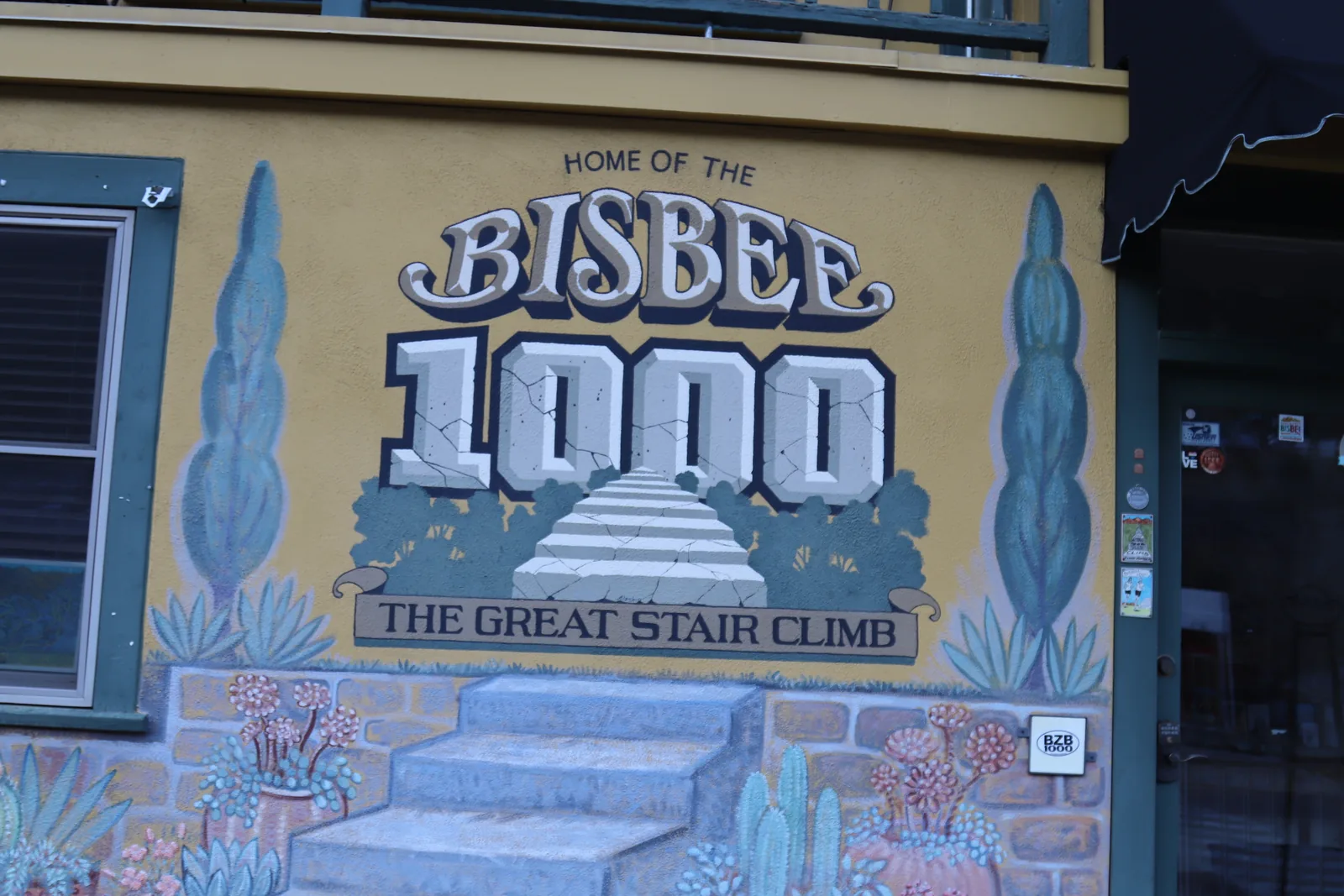
Bisbee is a town where the streets gave up and the stairs took over. The canyon is too steep for a grid, so the town connected its houses with concrete staircases instead of sidewalks. Once a year the town turns that into a race: climb the stairs, all of them, and the town watches. It is 4.5 miles, nine staircases, 1,034 steps, and about 1,175 feet of climbing, and the stairs are the point. The race exists because the stairs were already there.
What it is
The Bisbee 1000 is a timed stair-climb race and walk through Old Bisbee, run every October on the third Saturday. It is chip-timed, with staggered wave starts. In 2025 the waves ran 9:00 to 9:20 in the morning. It runs rain or shine. No dogs, no strollers, no substitutions, no refunds, and bib pickup is in person only.
The organizer calls it "the only outdoor stair climb in the U.S." and "arguably one of the most unusual and challenging events in the world." Those are the organizer's words, not a verified fact. What is verifiable is the shape of it: a race up the town's own staircases, on streets the town uses every day.
The race is a fundraiser. Entry fees and the event fund stair repair and restoration, the nine race staircases first, plus other local causes. Some of those stairs had not been touched since the WPA built them in the 1930s. A 2014 study found the race and its craft beer festival generated more than $477,000 for the city, hotels, restaurants, and shops, with an 80 percent return rate among participants. People come back.
The course
The race starts at the Iron Man statue, the Miners' Monument from 1935, concrete sprayed with copper on a granite block of the type used in early drilling contests. The address is 201 Tombstone Canyon Road. From there the course runs 4.5 miles through Old Bisbee, nine staircases connected by winding roads, with about 1,175 feet of elevation gain and loss.
The staircases run 73 to 181 steps each. The middle trio carries more than 500 feet of gain on its own. That is the part of the course where the race is decided and where first-timers learn what they signed up for. The organizer, Cynthia Conroy, has warned runners about the mistake of looking up at that stretch. Arizona Highways, covering the race in person, described the wheezing arrival at those middle stairs. Do not look up. Climb.
The route in order: the Iron Man start, historic downtown, Brewery Gulch past St. Elmo's, the oldest operating tavern, Central School, now an art center, and the YMCA beyond Stairway 2, Subway Street, the old high school beyond Stairway 3, a building so steep each floor has a ground-level entrance, the highest point at the top of Stairway 5 with the High Street views, the Cochise County courthouse and St. Patrick's Catholic Church, Fire Station 2, established 1914, on upper Tombstone Canyon, the southern hillsides where mine officials lived, and the top of Stairway 9. Then downhill to the finish.
The finish-line festival is at Higgins Hill Park: the awards ceremony, the souvenir store, and the beer. The park holds the fitness court Bisbee Vogue built with the city, opened in May 2021. The course loops out through the staircases and comes back to the hilltop district it started in.
Why the stairs exist
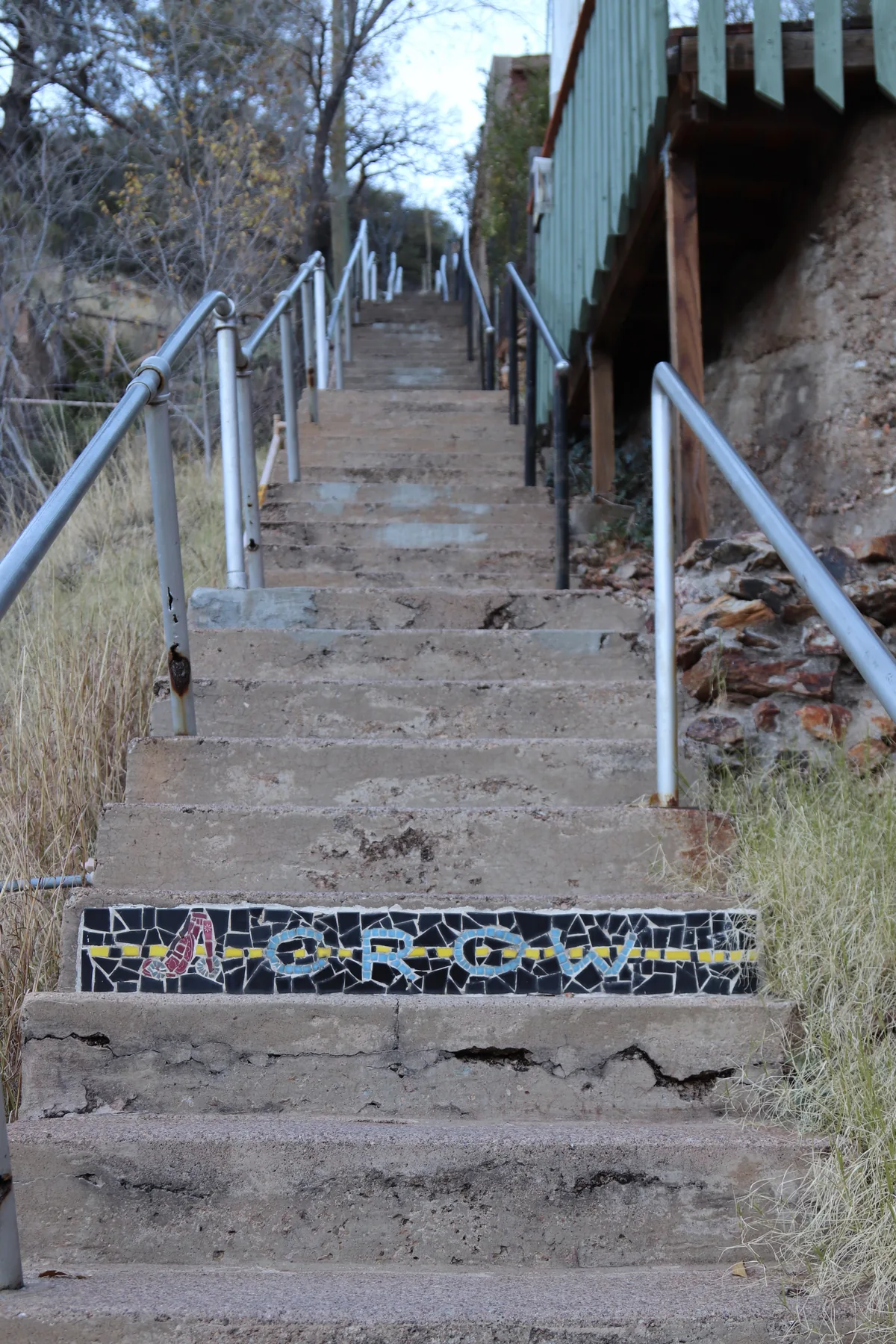
The stairs were mule paths first. During Bisbee's copper-mining heyday, mules wore paths into the hillsides between the houses and the mines. In the mid-1930s the Works Progress Administration put men back to work building concrete stairs over those paths. The town's own account says 1936 in most cases. The stairs are public walkways, and they have been ever since.
Bisbee Vogue, the nonprofit behind the race, partnered with the City to clean, restore, and install handrails on the nine race staircases, some untouched since the WPA built them. The race pays for the stairs, and the stairs are the race. That is the whole mechanism, and it is why the event has lasted.
Do not expect a single number for how many stairs the town has. The race map says 350 sets of stairs, Arizona Highways says some 33,000 concrete stairs, and Clio says around 1,000 staircases with about 30,000 steps. The sources cannot agree in the same units, so this page uses the race-course figures only: nine staircases, 1,034 steps. The step count itself has moved as the course changed; Arizona Highways reported 1,032 for the 2021 race.
The race's own history
Cynthia Conroy founded the race. The nonprofit behind it was Save Our Stairs, incorporated in 1990, renamed Bisbee Vogue, Inc. in 2013. Wick Communications bought the event from Bisbee Vogue in 2023, announced July 7 of that year, and now executes it.
The first race ran on October 19, 1991, with about 200 entrants who heard about it by word of mouth. The organizer's own pages say both 1990 and 1991; the edition arithmetic settles it at 1991. The 2021 race was billed as the COVID-delayed 30th anniversary, 2023 was the 32nd annual, and the 2027 race is billed the 36th annual. All three count back to 1991. The 1990 date is the year Save Our Stairs was incorporated, which is the organization's birth, not the race's.
The field grew fast and then got capped. From about 200 at the first race, it grew to 400, then 650. The 20th annual race drew 2,100, with congestion complaints on the stairs, and the cap came down to about 1,500 after that. Conroy planned to cut it to 1,000. The 2018 race drew 1,333. In 2023 there were 1,600 runners and walkers, ages 8 to 89, from all 50 states and internationally. The official site says children age 7 up to adults in their 80s.
The race was designated an Arizona Centennial Event in 2012 and won the Governor's Tourism Award for Special Events in a Rural Area the same year.
Who runs it
It is a destination event that still belongs to the town. Costumes are common. Firefighters run it in full turnout gear in 80-degree heat. Family reunions, school reunions, company teams, and birthdays run it together. At least one wedding proposal has happened on course. The awards are hand-painted, one of a kind, and you must be present at the ceremony to collect one.
The 2020 edition was cancelled for COVID. Every other year since the start, it has run on the third Saturday of October: October 16, 2021 for the delayed 30th anniversary, October 21, 2023 for the 32nd, October 18, 2025. The 2026 edition, October 17, has already passed. The next race is Saturday, October 16, 2027, at 9:00 AM, and registration is open now through Race Roster, linked from the official site.
Is it worth it
Yes, and you do not have to race it to get most of it. The whole 4.5-mile course is public and walkable any day of the year, for free, in about two hours. The nine race staircases are public walkways. Walk it on a weekday and you get the same stairs, the same views from the top of Stairway 5, and the same town, without the crowd or the entry fee.
The race adds three things the walk does not: the timing chip, the crowd, and the town at full volume, with the beer festival and the awards at the finish. If you want the race, register early. The cap has been cut before, and the field fills. If you want the stairs, go any Tuesday.
The people who have run it describe the same race. Arizona Highways, covering it in person, quoted Conroy's advice to use your arms as much as your legs on the stairs, and noted that marathoners have called it tougher than a marathon they ran two weeks before. Natalie Shalvoy, a three-time first woman finisher, called it "pretty terrible, in a good way." The 30-minute mark has been broken only once in the event's history.
Select a passage, then Share to send it with a link.
Questions, answered
- When is the next Bisbee 1000?
- Saturday, October 16, 2027, at 9:00 AM. Registration is open now through Race Roster, linked from the official site. It is the 36th annual race. Checked November 16, 2026.
- How much does the Bisbee 1000 cost to enter?
- Adult entry is $143.20 early bird (October 17 to 31) and $154.05 in the current tier (November 1 to December 31), rising to $159.48 and then $164.90 in later tiers. Youth entry, ages 7 to 17, starts at $34.73. Prices include mandatory charges, items, and fees. Every finisher gets a custom finisher medallion. Checked November 16, 2026.
- Where does the race start and finish?
- The race starts at the Iron Man statue, the Miners' Monument from 1935, at 201 Tombstone Canyon Road. The finish-line festival, with the awards ceremony, souvenir store, and beer, is at Higgins Hill Park.
- How far is the Bisbee 1000, and how many steps?
- 4.5 miles, nine staircases, 1,034 steps, and about 1,175 feet of elevation gain and loss. The staircases run 73 to 181 steps each. The middle trio carries more than 500 feet of gain on its own.
- Is it worth climbing?
- Yes, and you do not have to race it to get most of it. The whole 4.5-mile course is public and walkable any day of the year, for free, in about two hours. The race adds the timing chip, the crowd, and the town at full volume. J.D. Molinary, an untrained non-runner who finished the 2018 race in 1:03:34, wrote: "I'll never do it again."
Sources
Checked November 16, 2026.
- bisbee1000.org, the official site (checked November 15, 2026; re-checked November 16, 2026). Race format, course figures (4.5 miles, 9 staircases, 1,034 steps, about 1,175 feet), waves, rules, start address, the organizer's "only outdoor stair climb" claim, organizer history, 2027 registration open.
- Race Roster, 2027 36th Annual Bisbee 1000 event page (checked November 16, 2026). 36th Annual billing, Saturday October 16, 2027, 9:00 AM MST, Tombstone Canyon; adult and youth (ages 7 to 17) fee tiers; finisher medallion; prices include mandatory charges, items, and fees.
- bisbeevogue.org/impact, the organizer nonprofit's page. October 19, 1991 first race, 200 runners; Save Our Stairs incorporated 1990, renamed Bisbee Vogue, Inc. in 2013; stair restoration work.
- bisbeevogue.org/borc. Fitness court at Higgins Hill Park, opened May 2021, partnership with the City of Bisbee.
- Arizona Highways, Bisbee 1000 feature, reporting in person (2021). 1,032 steps for 2021, middle trio 500+ feet of gain, field growth 400 to 650 to 2,100, cap 1,500, 30th anniversary 2021, finish at Higgins Hill Park, arms tip, marathoners quote, 30-minute mark broken once.
- bisbeeaz.com, 2025 event post. Race figures, Wick Communications execution, WPA 1936 stair building.
- azbackcountryadventures.com, route walkthrough. Landmarks in order, course walkable any day, staircases 73 to 181 steps.
- Wick purchase article, July 7, 2023 (newspapers.org). Wick Communications bought the event from Bisbee Vogue in 2023; 2023 field 1,600, ages 8 to 89, all 50 states and internationally.
- Arizona Sonoran News, 2018 first-person account by J.D. Molinary. 1,333 entrants in 2018, 1,034 steps, 1:03:34 finish, Shalvoy quote.
- Clio, heritage stairs entry. Mule paths, WPA stairs, town-wide figure around 1,000 staircases and 30,000 steps (not used as a settled fact; see the stairs section).
- runrepublic.com. Race figures, 1,034 steps.
More from Bisbee
- What happened to the Queen Mine, and can you go down into it?
Bisbee lost the mine and kept the town. The Queen Mine closed in 1975; six months later the miners came back and started running the tours.
More to read
- Cottonwood’s chocolate shop began in a Michigan kitchen
The Michigan kitchen behind a Cottonwood chocolate shop, with truffle fillings to explore and a box to take home.
- A bookshop with a life after the last page
A bookshop that still acts like a small arts institution. Open daily in the Saint George lobby, with a gallery show on the record in June 2026.
- A quieter night under St. Augustine’s lights
More than three million white lights, free, over the oldest city in the country. Go on a weeknight, park once, and walk.