Solvang, California
Why is there a Danish village, windmills and all, in California wine country?
Solvang looks Danish because, in 1946, its people decided it should. The colony underneath the half-timbered facades is older, quieter, and real.
Tiny Towns USA team · · Updated
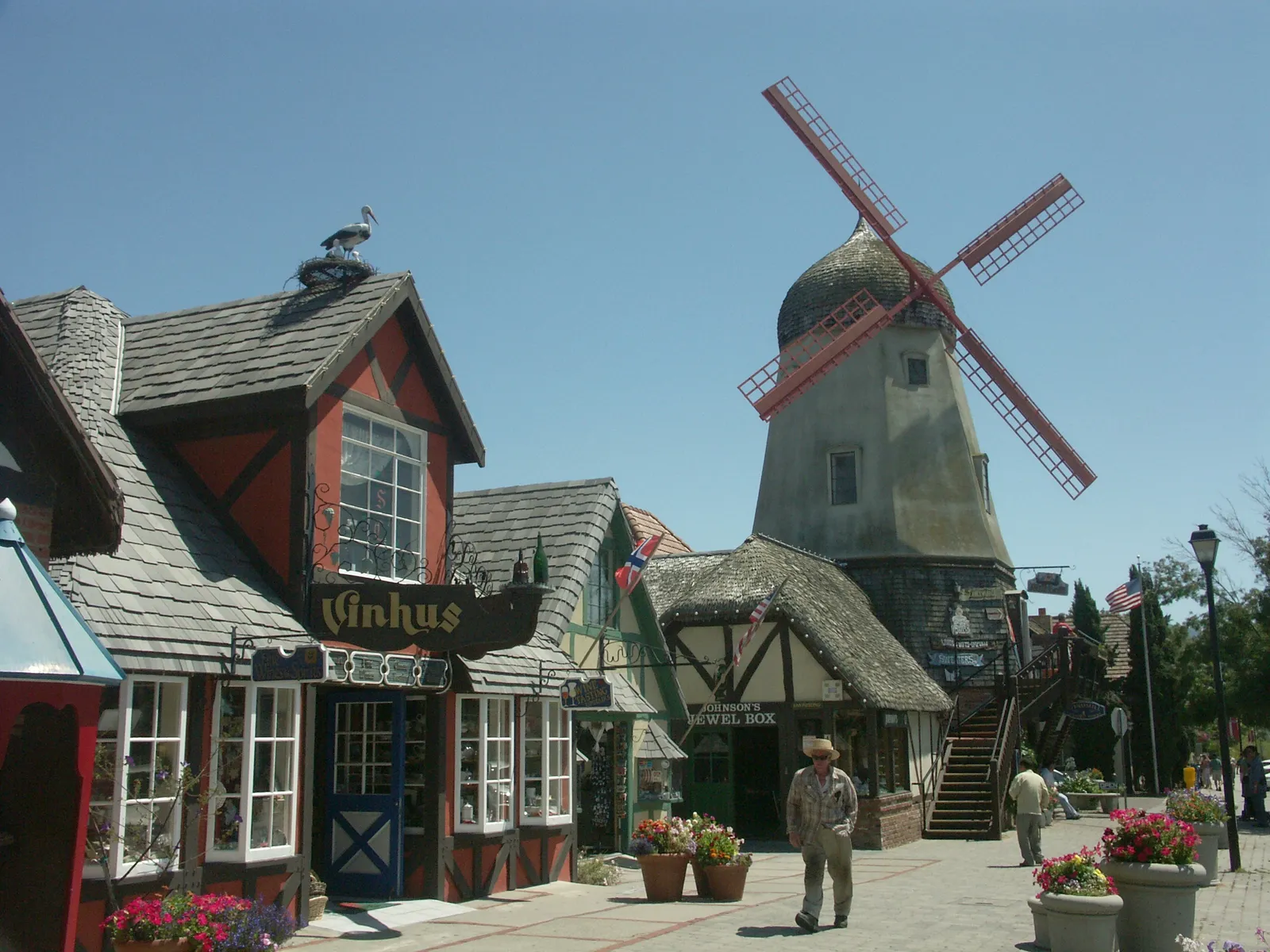
On January 12, 1911, three Danish educators bought almost 9,000 acres of the Rancho San Carlos de Jonata in the Santa Ynez Valley and named the colony Solvang, Danish for sunny field. They came to build a place where Danish culture could survive in America. For 35 years the town looked like any other small California farming town. Then, in 1946, its promoters rebuilt the main street as a Danish village, and a Saturday Evening Post feature on January 18, 1947, sent the tourists coming. Solvang has been two towns ever since: the colony the founders built and the village the town built for visitors.
Three teachers buy a ranch
The buyers were Rev. Benedict Nordentoft, Rev. Jens M. Gregersen, and Prof. Peder P. Hornsyld. They had formed the Danish-American Colony Company in San Francisco in 1910 and searched for land where Danish settlers could escape the Midwestern winters. They paid about $338,000 for the ranch land, roughly $40 an acre, to the Santa Barbara Land and Water Company.
The valley was not empty land waiting for a colony. It was Chumash land before the Spanish arrived, and Mission Santa Ines, founded September 17, 1804, by Father Esteban Tapis, stood beside the new colony as the 19th of the 21 California missions. The Danes built their town next to a mission that was already more than a century old.
The colony's first institution was its school. The folk school opened in November 1911 in a two-story building on Alisal Road at Mission Drive, with 41 students. The building still stands and now holds the Bit O'Denmark restaurant. A second, larger school followed: Atterdag College, a four-story building opened in 1914 on the hill, educated students through 1970, and was later torn down. The two schools are often confused. They were two different buildings, three years apart.
The colony years
For its first decades Solvang was a working Danish farming colony, not a tourist town. The founders' marker stands at 1660 Copenhagen Drive, where the Copenhagen House was built in 1913 as a bank and Colony Company offices, burned in 1925, and was rebuilt in 1926.
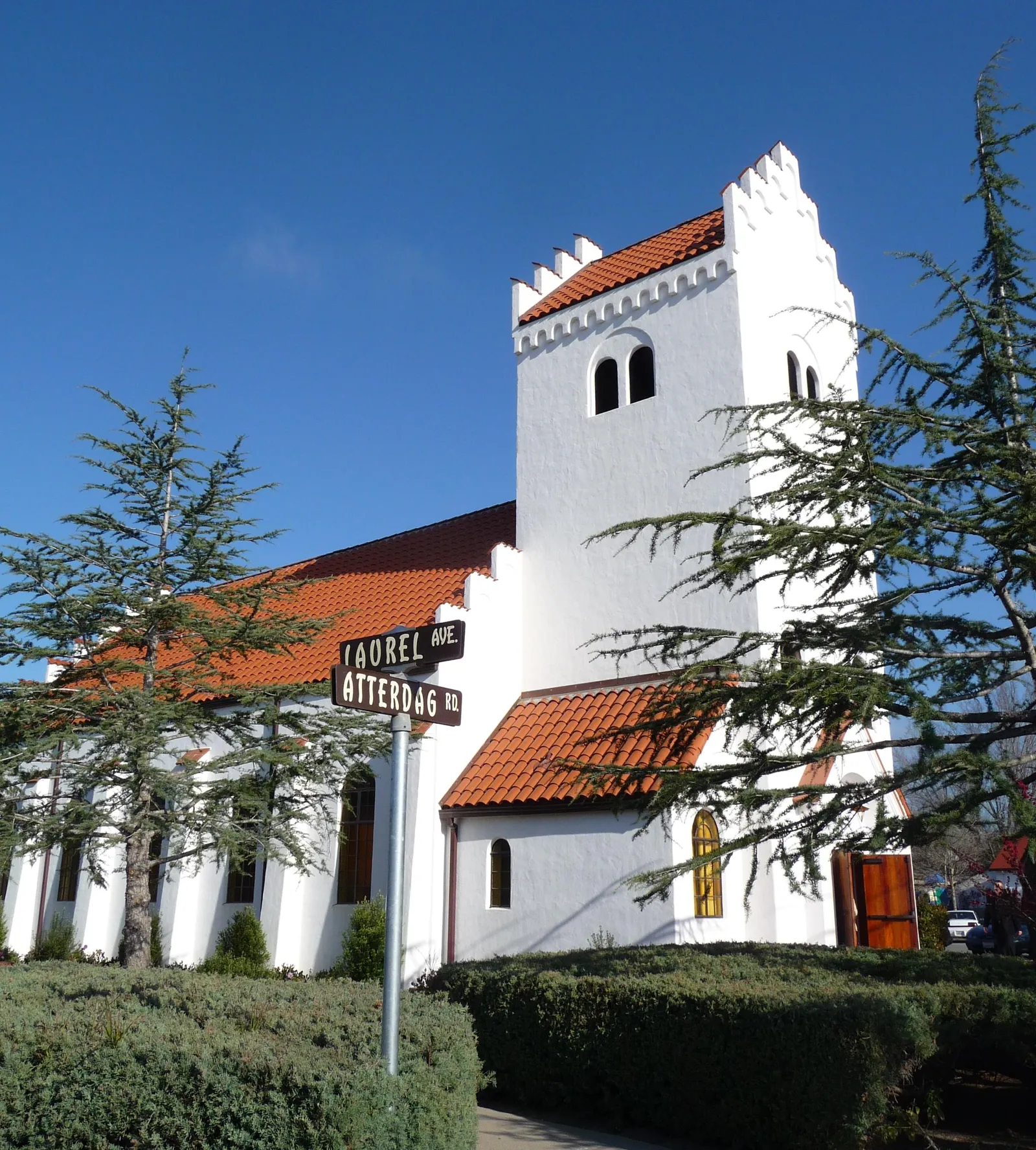
Bethania Lutheran Church, built in 1928, was the first building in town designed in a Danish style. A service is still held in Danish there on December 23. The church, the museum, and the festival are the living Danish institutions that survive from the colony years.
The first royal attention came in April 1939, when Crown Prince Frederik of Denmark visited and drew the first tourists. Princess Margrethe followed in 1960 and again in 1976, when her second visit earned developer Ferdinand Sorensen the Order of the Dannebrog. Prince Henrik visited in 2011. The town was incorporated as a city on May 1, 1985, and counted 6,126 residents in the 2020 census.
The turn: 1946 and the magazine
After World War II, Solvang's promoters made a deliberate decision. In 1946 the main street was renamed Copenhagen Drive, facades were rebuilt in half-timbered Danish style, faux storks went up on rooftops, and the style was mandated for new construction. The first windmill went up in the 1940s. The town was redesigned as a destination.
The Saturday Evening Post finished the job. Its feature on January 18, 1947, called Solvang a spotless Danish village that blooms like a rose in California's charming Santa Ynez Valley. Tourists arrived immediately, and they have not stopped. About 1.5 million visitors a year come to Solvang now, a figure the town's own reporting and a 2009 academic history both support.
The redesign worked so well that it is easy to mistake it for the whole story. The colony of 1911 and the village of 1946 are different projects by different generations, and the town's real history is the seam between them.
What is real and what is set-dressing
The honest split is this: a minority of Solvang residents are of Danish origin in the 21st century, and the town is more tourist attraction than living Danish community today. What is still living is the church, Danish Days, and the Elverhoj Museum of History and Art, which traces the founding. Do not call Solvang a living Danish town. Call it what it is: a real colony that dressed itself as a village and kept the institutions that mattered.
The four downtown windmills are decorative, not functional, and each has an address: the Solvang Windmill at 436 Alisal Road next to Solvang Bakery, the Hamlet Square windmill at 1622 Copenhagen Drive behind Solvang Trolley Ice Cream Parlor, the Solvang Brewing Company windmill at 1547 Mission Drive, and the Kronborg Inn windmill at 1440 Mission Drive. Two more stand beyond the center: the Sorensen windmill on Old Mill Road and Wulff's windmill on Fredensborg Canyon Road.
The replicas are the point of the village, and they are worth naming as replicas. The Round Tower behind one of the windmills is a one-third scale copy of Copenhagen's 17th-century Rundetaarn, built in 1991 by Paul Hanberg from drawings of the original. The Little Mermaid is a half-size bronze copy in the fountain in Denmarket Square, at Mission Drive and Alisal Road. The King Christian Tower, also called the Dragon Spire, copies Copenhagen's old stock exchange tower, and since the Copenhagen original burned in 2024, Solvang's replica is now the only one standing. A bust of Hans Christian Andersen stands in Solvang Park, and a replica of the Copenhagen City Hall Clock Tower and a giant red clog at First Street complete the set.
The Danish table
The Danish food is the part of the village most visitors actually taste. Æbleskiver, the round pancake balls, are the signature Danish bite. Danish pancakes come from Paula's Pancake House at 1531 Mission Drive. Olsen's Danish Village Bakery, Danish owned for four generations, bakes kringle at 1529 Mission Drive. Mortensen's Danish Bakery stands in Petersen Village Square.
Bit O'Denmark, in the 1911 folk school building on Alisal Road, serves flæskesteg, roast pork. The Red Viking at 1684 Copenhagen Drive serves an all-you-can-eat Scandinavian smorgasbord. The bakeries and the table are where the colony's food survived the village redesign, and they are the most direct way to taste what the founders brought with them.
Walking the founding story
Start at 1660 Copenhagen Drive, where the founders' marker and the Copenhagen House stand at the corner of Copenhagen Drive and First Street. From there, the folk school building is a short walk down Alisal Road, now the Bit O'Denmark restaurant, and Bethania Lutheran Church is the 1928 building that first gave the town a Danish silhouette.
Elverhoj Museum of History and Art traces the founding in the building constructed almost entirely without nails. Mission Santa Ines, a short drive from the village center, is the 1804 mission that predates the colony by more than a century and anchors the valley's longer history.
Danish Days has run nearly every year since 1936, when it began as the colony's 25th-anniversary celebration. The 89th edition ran September 18 to 20, 2026. The 90th anniversary runs September 17 to 19, 2027. The 2004 film Sideways was shot in Solvang and the surrounding wine country, which is the other reason many visitors arrive already knowing the town's name.
Select a passage, then Share to send it with a link.
Questions, answered
- When was Solvang founded, and by whom?
- Solvang was founded January 12, 1911, when three Danish educators, Rev. Benedict Nordentoft, Rev. Jens M. Gregersen, and Prof. Peder P. Hornsyld, bought almost 9,000 acres of the Rancho San Carlos de Jonata through the Danish-American Colony Company they had formed in San Francisco in 1910. They paid about $338,000, roughly $40 an acre.
- Why is there a Danish village in California wine country?
- The Danish colony was real: educators bought the land in 1911 to keep Danish culture alive in America. The village look came later. In 1946 the town redesigned its main street as a Danish village, and a Saturday Evening Post feature on January 18, 1947, turned the colony into a destination. About 1.5 million visitors a year come now.
- Is Solvang still a real Danish town?
- Only in part. A minority of residents are of Danish origin today, and the town is largely a tourist attraction. What is still living is Bethania Lutheran Church, built in 1928, with a Danish-language service on December 23, the Danish Days festival, held nearly every year since 1936, and the Elverhoj Museum of History and Art.
- Are the windmills and statues real?
- The four downtown windmills are decorative, not functional. Two more stand beyond the center. The Round Tower is a one-third scale replica of Copenhagen's Rundetaarn, built in 1991. The Little Mermaid is a half-size bronze copy. The King Christian Tower copies Copenhagen's old stock exchange tower, and since the original burned in 2024, Solvang's replica is now the only one standing.
- When is Danish Days 2027?
- The 90th anniversary of Danish Days runs September 17 to 19, 2027, Friday through Sunday. The festival began in 1936 as the colony's 25th-anniversary celebration and has run nearly every year since. Confirm dates against the festival's own pages before planning a trip.
Sources
Verified November 23, 2026.
- Wikipedia: Solvang, California
- Foo Howser: Solvang
- Visit Solvang: Danish heritage and culture
- Dorothy C. Brand oral history, May 10, 1979 (Santa Ynez Valley Historical Museum)
- Clara Nielsen Petersen oral history, Feb 4, 1980 (Santa Ynez Valley Historical Museum)
- Holm and Christensen, The Bridge vol 32, 2009: Denmark Our Heritage, America Our Home
- HMDB: Solvang founders marker
- Visit Solvang: Danish Days
- Danish Days Foundation: 87th annual, 2024
- Europe Says: Solvang replicas
- Travel the Food for the Soul: Solvang windmills
- Visit Solvang: arts and culture
- The Culture Trip: a brief history of Solvang
- Wikivoyage: Solvang
More to read
- What happened to the people who lived in Gettysburg?
Gettysburg was a town of 2,390 before it was a battlefield. Jennie Wade was killed kneading dough in her sister's kitchen, and thousands of wounded men filled the town's churches, barns, and parlors.