Marfa, Texas
A Saturday at the basketmaker’s table
Sarita Westrup turns memories of the South Texas border into woven sculpture. Two December workshops at Chinati offer a way into her practice, even for a beginner.
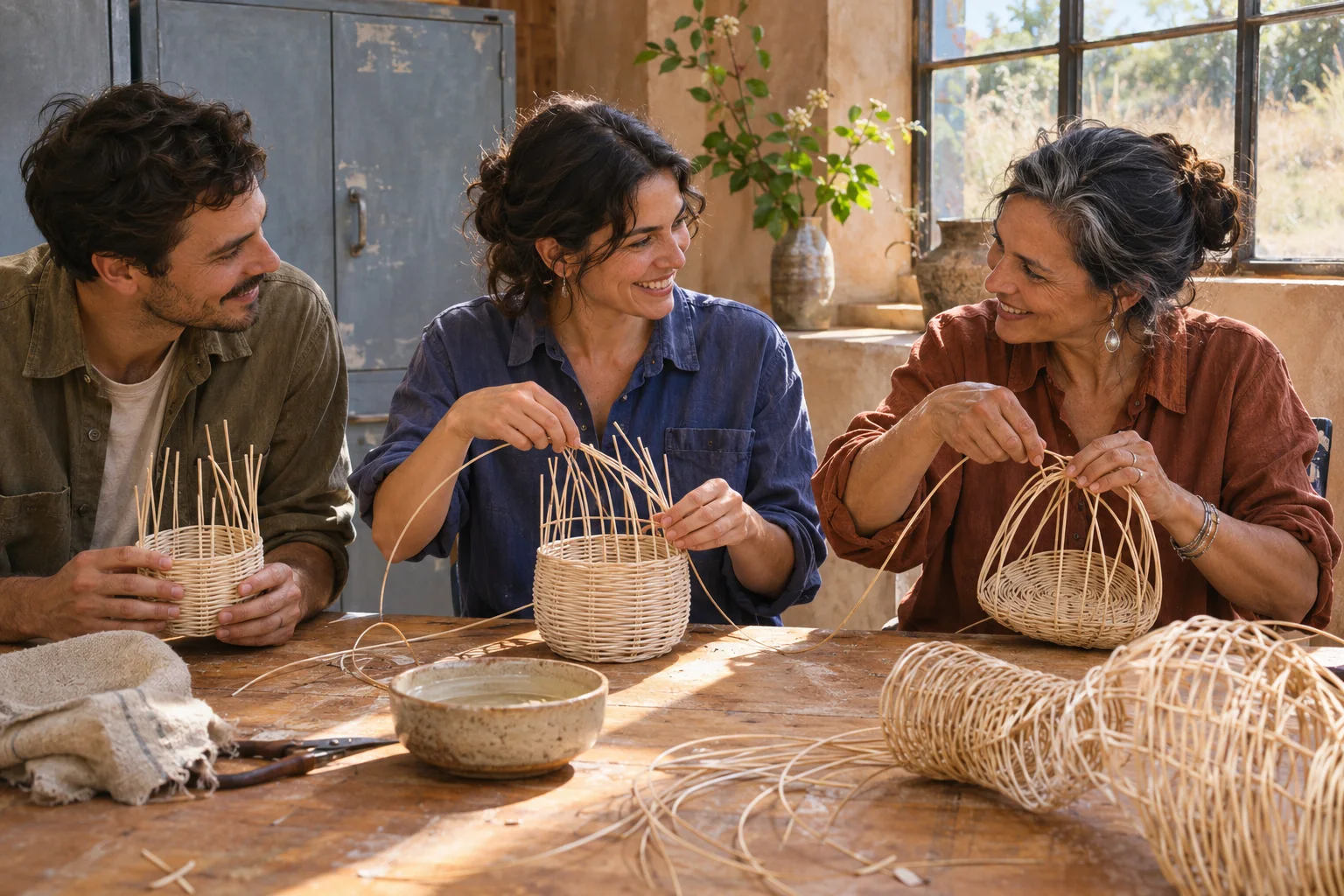
Sarita Westrup makes baskets with tunnels, loops and room for light to pass through. She grew up in the Rio Grande Valley, and the border runs through her thinking about what a woven form can hold. On December 12 and 13, 2026, she is teaching two free workshops at Chinati in Marfa. The reason to go is the chance to work with an artist whose familiar materials have become a language of their own.
The border in a basket
Westrup grew up in the South Texas borderlands and earned her MFA in fiber arts at the University of North Texas in 2016. Her sculptures keep returning to the place she came from. A basket’s open weave lets air through. A border fence divides a landscape. She puts those two structures into conversation.
In her 2024 essay for The Nasher, Westrup describes turning the border into tunnels, archways and passages. She has worked with the Klein bottle and the Möbius strip, mathematical forms that let her think about continuous movement and connection. Reed, mortar, paint and agave fiber appear together in her work. These are baskets carrying an idea about home.
That makes a beginner’s lesson an interesting way to meet her work. Twining reed is one of the techniques behind the sculpture. You can begin with the material and see how a series of small decisions becomes a form.
Teaching helped build a working life
Westrup has been teaching workshops since 2012. In an interview with 3pts, she described keeping that work going alongside part-time arts jobs before becoming a full-time artist. A residency at Arts Fort Worth, an American Craft Council cohort and savings helped her make the change. The relationships built through teaching gave her people and places to keep working with.
She also described pairing gallery shows with workshops. People could see the sculpture, then spend time making a functional object themselves. Teaching, exhibitions and sales became parts of the same working life.
This is the part of an artist’s career a visit to an exhibition can leave out. Someone has to make the work, find time for it and keep a studio going. Westrup has spoken plainly about that effort. A class puts you alongside the practice: choosing a material, learning what it will do and staying with a shape while it develops.
A place for Marfa to make things
Chinati’s education program serves the schools and communities of the Big Bend region. Its Art Lab is a place for making work, and the museum offers programs for children, families and adults. A public workshop gives a traveler a way to take part in that side of Marfa.
For this visit, the useful question is what you want to spend time doing. If you enjoy following an artist’s choices closely, the basketry session gives you several hours with one material and a technique to learn. If you are coming with children, the Sunday workshop is specifically welcoming families. Both begin without an expectation that you already know how to weave.
Reed on Saturday, cardboard looms on Sunday
Saturday’s Sculptural Basket Weaving session uses reed and a premade basket base. Westrup will introduce twining as participants build a form. Materials are included, and Chinati asks participants to bring lunch. Registration is required.
Sunday’s Loom as Object session uses frame looms made from repurposed cardboard. It is a drop-in workshop, with families and children encouraged to attend. The interest here is color, texture and pattern, with a simple frame holding the work while it grows.
Choose the longer Saturday session if you want to concentrate on sculptural basketry. Sunday is the clearer fit for a family wanting an introduction to weaving without committing to the full Saturday. The current dates and organizer’s details are below; the town calendar brings together the other activities we cover in Marfa.
Select a passage, then Share to send it with a link.
Weaving at Chinati, December 12 and 13
Basket weaving with Sarita Westrup
10:00 AM CST to 3:00 PM CST · Chinati Foundation Art Lab · Free, with registration
Westrup’s sculptural baskets draw on her South Texas borderland home. This session starts with reed, a premade base and twining, giving beginners several hours to learn how a woven form takes shape.
The Chinati Foundation. Checked Nov 17, 2026.
Weaving with cardboard looms
10:00 AM CST to 2:00 PM CST · Chinati Foundation Art Lab · Free, drop-in
A cardboard frame becomes a loom for color and pattern. Chinati welcomes families and children to this drop-in session with Westrup, whose own work treats weaving as sculpture.
The Chinati Foundation. Checked Nov 17, 2026.
Sources
Checked November 16, 2026.
- The Chinati Foundation: December 12 and 13 weaving workshops
- Sarita Westrup: artist biography
- Sarita Westrup, Weaving the Borderlands, The Nasher, Fall 2024, pages 61 and 62
- 3pts: About the Time I Said Yes, an interview with Sarita Westrup
- The Chinati Foundation: education program
- The Chinati Foundation: education internship and Big Bend community work
More from Marfa
- A bookshop with a life after the last page
A bookshop that still acts like a small arts institution. Open daily in the Saint George lobby, with a gallery show on the record in June 2026.
- Two bootmakers gave Marfa a different kind of art
How Logan Caldbeck and Colt Miller turned a riding boot and a desert boot into a Marfa business. Visit the lumberyard shop with a closer eye for the craft.
- Can I park my RV or camper overnight in Marfa, and if so, where?
Marfa bans sleeping in a rig on a public street at night. Three parks near town take overnight rigs, and the campground most visitors remember is closed.
More to read
- Cottonwood’s chocolate shop began in a Michigan kitchen
The Michigan kitchen behind a Cottonwood chocolate shop, with truffle fillings to explore and a box to take home.
- A quieter night under St. Augustine’s lights
More than three million white lights, free, over the oldest city in the country. Go on a weeknight, park once, and walk.
- Can you get to Cooke City in winter, and is the Lamar Valley dawn worth the drive?
One road in, 77 people, and the best wolf watching in the country at dawn. One night is enough, and it is the point.